Fall is in the air here in the
Ozarks. We’ve finally gotten a reprieve
from some of the heat and humidity. In
some ways, it’s been a long, hot summer.
Then again, I keep wondering where all of the time goes? Over the last few months, we’ve been consumed
with work, travel, and even more special projects. In the middle of it all, we’ve received a
number of notices related to upcoming events.
Unfortunately, we’re not able to post everything we receive but in an
effort to share some of the announcements, below are details from a pair of
press releases sent to us.
Wednesday, September 17, 2014
More 2014 Chuck Wagon Events
Wednesday, September 10, 2014
Carriage Association of America
Locating detailed information on early
wagons and stagecoaches isn’t always an easy task. Some particulars can only be found in period catalogs
and materials produced by vehicle builders while other data may have to be
mined from scarce periodicals, old government records, or other
references. While many folks use the
internet as an immediate ‘go-to’ resource, the very nature of massive amounts
of data being posted online can make it tough to confirm reliability in all
instances.
Equally important is the point that
there is a host of well-researched information not currently available on the
world wide web. In fact, many materials
originally published decades ago have never been posted on line. A good reminder of this can be found by
perusing early issues of “The Carriage Journal.” The magazine, published by the Carriage Association of America (CAA), is well-known for producing quality, well-written,
and well-researched details on a host of vehicle styles, including America’s
heavier wagons and stage coaches.
A few years ago, I acquired a hardbound collection of the earliest years of this magazine. Within the Summer 1965 issue, I came across a multi-page story covering the famed 20 Mule Train and giant freight wagons used to haul borax through Death Valley. The article includes an overview of the wagons as well as discussions related to the mule teams, muleskinning, the desert terrain, and the early Pacific Borax Company.
![]() |
The Wheels That Won The West® Archives includes countless unpublished and rarely seen photos from America’s first transportation industry. |
In another article from a half century
ago, the CAA covered the restoration of Abbot-Downing’s coach #431. A 1964 write-up highlighted the wagons and
carriages built by James H. Birch of Burlington, N.J. and still another in 1967
focused on the firm of Hoopes Bro. and Darlington in West Chester,
Pennsylvania. At the time, they were
still busy building wagon wheels; a business started 100 years earlier in
1867.
More than quaint stories from another
time, these are touch points in history; allowing us more opportunity to learn
about specific vehicles while potentially reinforcing provenance
documentation. Likewise, such articles
can be helpful within identification and authentication work. With a history dating to 1960, the Carriage
Association of America is a strong organization helping bring like-minded folks
together while promoting horse-drawn vehicle history and modern day
applications. They’re located at the
Kentucky Horse Park in Lexington, Kentucky.
If you’ve never been there, it’s well worth the visit.
Wednesday, September 3, 2014
Uncommon Wagon Patents
There are a number of early
vehicle-related patents that were so well accepted that they became common in
commercial use back in the day. The
successes of inventors with last names such as Sandage, Comstock, Burr, Archibald, Stoddard, and Sarven are well documented and were equally
well-known by vehicle builders in the 1800’s and early 1900’s. You may have heard of the ‘Sandage skein’ or
the ‘Archibald hub’ or even the ‘Comstock end gate’ as I had covered earlier this
year.
There are countless other expired patents
that most living souls have never heard of and, if it weren’t for this blog, they
might be completely forgotten. That’s
not to say that you’re missing much as many of those patents never got off the
ground. Some failed completely while
others saw only a glimmer of success. As a
result, the odds of finding most of them today are in the neighborhood of ‘slim
to none.’
That said, several years ago, I came
across a device clamped to the hub and spokes of a wagon wheel. It looked like a steel spider with the wooden
wheel firmly in its grip. To understand
its purpose one needs to look no further than the weaknesses faced by wooden
wheels. No matter the end user – farmer,
rancher, miner, business owner, freighter, etc. – many faced the eventual
challenge of loose spokes, felloes, and tires as well as shrinkage and
unsoundness in the hubs. As with the
multitude of vehicle problems that can surface today, the issues often occurred
when help was not close at hand. This
particular spider-like clamp was engineered to stiffen and reinforce the entire
body of the wheel – hub, spokes, and felloes – while helping temporarily fix a
serious concern. Even though I’d
stumbled upon the device in the 21st century, it’s an idea with roots over 130
years old. The following illustration outlines
the concept. It’s from a patent applied
for in 1883.
![]() |
Many issues can cause weakness in wooden wheels. Sometimes a quick fix was needed before a more permanent repair could be made. |
A few years earlier, in 1880, another
gentleman believed he had the answer for strengthening and stabilizing wagon
bows. This design called for framed slots
made of cast metal that would contain the ends of a wagon bow, preventing it
from over-flexing or slipping down on the box lower than it should. Both scenarios could result in breakage and
other problems. The image shown below is
from that patent.
![]() |
As reflected in this 1880 wagon bow innovation, patents and special design innovations covered virtually every aspect of a wagon's construction. |
While patent applications related to
wagons did slow down after the introduction of the automobile, there continued
to be those willing to spend money to register their ideas well into the 20th
century. Below is an approved patent that
combined box tighteners with rub irons – two features with totally different
functions. Essentially, a box tightener is
a large clamp that helped seal the side(s) of a wagon box equipped with multiple
sideboards. On the other hand, a rub
iron is a metal shield designed to protect the lower box sides from being damaged when the
front wheel is turning.
![]() |
This idea for a combined rub iron and box tightener was filed in 1919 – a bit late for any real commercial success with wooden wagons. |
It’s always interesting to flip through
the dusty pages of these old patent files.
After all, we’re all connected to yesterday and many of those early
innovations are still being used in some way or another. So, while you’re traveling through each day, keep
your eyes open for different-looking pieces and don’t be afraid to ask
questions. Luck happens a lot more often
when you work at it.
Wednesday, August 27, 2014
Deere & Webber
Any study of early wooden wagons and the
associated industry will quickly show that the subject is full of twists,
turns, tragedies, and confusing similarities.
When reviewing a brand’s origins, things can get especially tricky if too
much attention is given to the name alone.
As I’ve shared before, jumping to conclusions by focusing on just one
vehicle trait can quickly turn problematic.
Case in point; some may know that there
were multiple brands using the name ‘Whitewater.’ Others may not be aware that there was more
than one Columbus brand. Mitchell wagons
may have been the “Monarch of the Road,” but ‘Monarch’ was also a label owned
by another well-known firm. These same-name
challenges can also be applied to other prominent brands such as Bain, Fish
Bros., Brown, Smith, and more.
With this said, it’s not surprising to
know that the firm of Deere & Webber has sometimes been mistook as a
relative of the Weber (one ‘b’ versus two) Wagon Company from Chicago. Even the legendary Weber & Damme of St.
Louis as well as some local retail outlets have been confused with other brands
carrying the Weber name. For the record,
those mentioned above are separate entities with each being a full-fledged
competitor of the other.
![]() |
As with the John Deere name itself, the Deere & Webber firm was a trusted and exceptionally competitive brand. |
The Deere and Webber brand is especially
interesting as its primary role was that of a branch house or wholesale distribution
outlet in Minneapolis, Minnesota. John
Deere had a number of these outlets including Deere & Mansur as well as Deere,
Wells and Co. and others. While John
Deere did have part ownership in these firms, they were run with some latitude
from company headquarters in Moline, Illinois.
For instance, while the sales staff at Deere and Webber were encouraged
to sell John Deere products, they also sold non-Deere brands including their
own house brands. Additionally, they
were known to engage dealers that sold competing brands to Deere. While this was not the preferred direction,
it did happen enough that sales representatives were repeatedly reminded of the
importance of establishing ‘full line’ John Deere dealers. In time, Deere bought each of the
distribution houses outright.
Anyone believing these early agriculture
and wagon companies were unsophisticated and casual in their approach to the
selling process has simply not studied enough period business correspondence. The most prominent of brands worked hard to dog,
defend, and dominate every trade area possible.
Broader product lines designed to meet the price points of competitors
helped many traveling agents accomplish the quotas and directives they were
given.
![]() |
Early company bulletins helped keep marketing directions and messages consistent among the company’s network of traveling sales representatives. |
In the case of Deere and Webber, 1910 was a significant year for the company. The home office in Illinois had just purchased the legendary Moline and Fort Smith Wagon companies and was in the process of developing the first ‘John Deere’ branded wagons. Even though Deere & Webber had beaten the main office to the punch by putting their own label on wagons several years earlier, the day was coming when the name ‘John Deere’ would stand alone as the best of the firm’s wagon offerings. It was all part of an effort to build on the tremendous equity of the Deere name.
Today, the John Deere legacy remains a
powerful force in agriculture but also benefits significantly from its growth
in the construction, turf, and forestry divisions.
Wednesday, August 20, 2014
More Wyoming Wagons
Congratulations to all of the participants
at the recent Wyoming State Fair Sheep Wagon competition. It was an impressive event, kicked off with a
great chuck wagon breakfast on Sunday morning.
I had the privilege of participating in the wagon judging and can’t say
enough about how warm and welcoming everyone was. The wagon display included a wide variety of
styles including a WW1 era Army Escort wagon, multiple chuck wagons and buggies
as well as fourteen sheep wagons signed up for the competition.
Vehicles from the late 1800’s through
the early 1900’s were represented with about an equal number of wooden wheeled
and rubber-tired sheep wagons shown. Box
makers we could conclusively determine included Florence and Home on the Range. I was also able to identify running gears
originally built by makers such as Bain, Mitchell, Peter Schuttler, Owensboro,
Studebaker, Winona, John Deere, and Stoughton.
Author, sheep wagon authority, and fellow judge, Tom Lindmier, was
gracious enough to show me a few more wagons in the area. It all made for a full and memorable
trip. Below is a brief look at a few
winners from this year’s Wyoming State Fair Sheep Wagon Competition.
![]() |
Classified in the "Restored with Modifications" category, the Valentine Sheep wagon entry captured this segment. |
![]() |
New for this year, the "Personal Touch" category helped highlight some of the more customized Sheep Wagon entries. The Garber entry received the highest total points in this class. |
![]() |
John Sullivan and the Sullivan Ranch took home top honors in the “Unrestored Working” sheep wagon classification. His wagon is an original “Home on the Range” brand. |
![]() |
In the "Unrestored Original" category, Bob Vollman received the most points from the 4 judges. His original Florence bed was mated to a Mitchell running gear. |
![]() |
The "People's Choice" sheep wagon award went to Richard Kaan from the Fall River Carriage Company. |
Thanks, again, to the event organizer, Steve Shadwick, and all of the great folks
at the Wyoming State Fair. The wagons at
the gathering represented a good cross-section of early manufacturers. Some of the period designs rode on Mountain
Wagon gears with steel skeins (correctly pronounced with a long ‘a’ as in “skains”)
while others were equipped with cast skeins.
Combined with comfortable weather and a super-friendly atmosphere, the
only thing missing for me was the opportunity to stay longer. After two days at the fair, work was calling
and it was time to hit the trail once again.
My trip to the region took me past old stage stations, military forts, sections
of the Bozeman and Oregon Trails, numerous museums, and even a historic buffalo
jump. One thing’s for certain, if you
enjoy America’s western history and early wagons, this annual event – and the
entire area – should be on your bucket list.
To punctuate that a bit, in an upcoming blog we’ll share even more about
several additional wagons located on the Wyoming State Fairgrounds in Douglas.
Wednesday, August 13, 2014
Coaching in Mariposa Grove
In late 2011, I made a commitment to
write a weekly blog with subject matter directly related to the heavier horse
drawn vehicles that helped build America.
In addition to the dozens of feature length articles I’ve been fortunate
to share, this week’s blog marks my 150th post.
As a way of highlighting that personal milestone, there is another
reason the ‘150’ number is special this year.
2014 marks the 150th Anniversary of the creation of Yosemite
Park by Abraham Lincoln.
![]() |
The Yosemite Stage & Turnpike Company offered breathtaking tours of some of America’s most beautiful scenery during California’s early coaching days. |
![]() |
Doug Hansen and his team of professionals at Hansen Wheel & Wagon Shop completed this restoration of a vintage Yosemite coach several years ago. |
The Park and the giant sequoia trees in
Mariposa Grove have a long and storied history connected to coaching in the
West. In 1877, thirteen years after
President Abraham Lincoln ceded Yosemite to the state of California, the
Yosemite Stage and Turnpike Company began offering stagecoach tours to Mariposa
Grove, the largest stand of giant sequoias in what became Yosemite National
Park in 1890. The sequoias are much the same today, but many of the open-sided
touring coaches are gone. To get to the
Big Trees by stage in the early days, drivers had to negotiate steep, narrow
mountain roads with sheer drops and difficult switchbacks. On a few occasions,
masked highwaymen disrupted these outings.
In fact, during the first recorded robbery in 1883, passengers forked
over an amazing $2,000 worth of cash and jewelry. Even without this
extracurricular excitement, the tours often took all day.
With a continuing interest in these
specially designed vehicles as well as other stage and mountain wagons used in
the late 1800’s and early 1900’s (and the fact that I’ve always wanted to see
the giant redwoods up close), my wife and I made another trek out West a few
months ago. As part of the venture, we
made sure to include Mariposa Grove in our trip. From the legendary Half Dome granite rock to
giant waterfalls, scenic roads, wildlife, and the big trees themselves, the
area is incredibly beautiful and rich in American history.
Reaching the parking lot of the Grove
well in advance of the tour buses, we were among the first to arrive. The
morning air was cool but extremely comfortable for our 4 mile round trip hike
into the impressive trees. Within sight
of our parking spot we encountered one of the legendary trees often shown in
the early coaching photos. It was the
‘Fallen Monarch’ which is believed to have met its demise more than 300 years
ago. Climbing on this still-imposing
piece is prohibited today but there are a number of photos from 19th century
excursions showing horses, riders, coaches, and sight seers all atop this
monstrous tree. The acids in the wood
help prevent decay, so a number of the oldest toppled giants are still here to
view.
![]() |
The photos above show the legendary ‘Fallen Monarch’ tree as it appeared in the late 1800’s as well as today. |
Moving up the well-marked trail, we began
to hear the first rumblings of the tour vehicles. In some cases, these open air buses are
traveling the same paths as the early horse drawn coaching parties did. Just over 2 miles up a zig-zagging mountain
trail was a tree I’ve wanted to see for decades. It is the giant Tunnel Tree that has been the
subject of so many photos over the years.
Period images often show early coaches, mountain wagons, and automobiles
being driven through it. As a bit of
background to the Tunnel Tree’s history, the Yosemite Stage and Turnpike
Company hired two brothers in 1881 to cut an eight foot wide tunnel through the
heart of the redwood, also known as the “Wawona” Tree. The brothers were
paid $75 to create a passage more than 26 feet long and 10 feet tall. The
majestic tree stood over 230 feet in height until it fell in 1969 under an
especially heavy crown of snow.
![]() |
Perhaps the most famous tree in Mariposa Grove is the “Wawona” or Tunnel tree. It was a favorite place for ‘drive-thru’ photos for almost a century. |
![]() |
The two photos above show the legendary Wawona as it appears today. It lays where it fell in 1969. A close look reveals the old road beneath the giant. |
While it’s sad to see the fallen hulk on
the ground, there is something especially grand about this tree that puts life
in greater perspective. Prior to its
fall, it was sometimes promoted as the “Oldest Living Thing.” Believed to be as much as 2,300 years old
when it fell, it stretched more than 230 feet into the air, was standing during
the birth of Jesus Christ, and dwarfing the forest floor when Columbus stumbled
upon the Americas. Billions of people
lived their lives from start to end during the lifespan of this behemoth. It was a privilege to see while walking some
of the same trails taken by early horse drawn coaching parties.
Just a few miles from Mariposa Grove is
the Pioneer Yosemite History Center. The
facility contains a number of historic structures related to Yosemite as well
as a significant collection of early western vehicles. We’ll cover some of those special sets of
wheels in an upcoming blog. In the meantime,
if you haven’t yet signed up to receive this weekly blog via e-mail, just type your address in the "Follow By E-mail" section above. You'll receive a confirmation e-mail that you'll need to verify before you're officially on board. Please don't hesitate to let us know if we can be of assistance. We're looking forward to your visits each week.
Wednesday, August 6, 2014
Wyoming Sheep Wagons
This year marks the 130th
Anniversary of the construction of the first sheep wagon built by James
Candlish. Many have attributed the invention
of the vehicle to Mr. Candlish while others believe William McIntosh, Jacob
Jacobsen, or George Ferris should receive credit. There will likely always be discussion as to the
who, when, and where’s of the first sheep wagon but, the recognition of
Wyoming’s leading role in its creation is undisputed. Locations such as Douglas, Casper, Cheyenne,
Buffalo, and Cody have a long and legendary connection with the vehicle. Today, the state continues to celebrate its
rich western heritage with the 102nd Wyoming State Fair taking place
from August 9-16. Activities included in
the week-long event include a Dutch oven cooking contest, rodeo, ranch horse
event, and sheep wagon competition.
![]() |
A rare early image showing a pair of Florence Hardware Sheep wagons. The original photo has crisp details and is part of the Wheels That Won West® Archives. |
Sheep wagon competitors are judged on
the quality of the running gear, roof construction, doors/windows, accessories,
stove, history, and other pertinent traits.
The gathering at this year’s fair will include a wide variety of wagons
and plenty of ranching history from our nation’s past. While regional builders/sellers of these
wheels – such as Florence Hardware, A. & A.C. Rice, J.C. Jacobsen, and F.L.
Belcher – often gain a fair amount of attention, there were several prominent
national manufacturers of Sheep Camp wagons as well. Among the host of makers were the Studebaker,
Stoughton, Winona, and Kentucky wagon companies. Each capitalized on the growing sheep
industry during the late 1800’s and early 1900’s and each offered customized
variances on a standard design. Today,
these special vehicles are still popular with ranches, collectors, lodges, businesses,
and others.
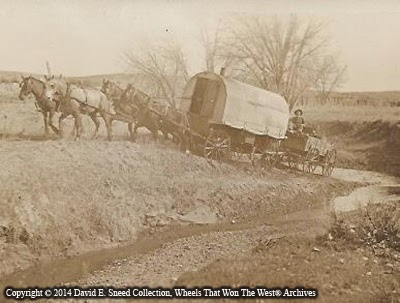
![]() |
This Sheep Camp wagon has a Peter Schuttler supply wagon in tow as it crosses a low, narrow portion of the Powder River. |
For those in the area of Douglas,
Wyoming on August 9th, this year’s sheep wagon competition at the Wyoming State
Fair will present a great opportunity to see some impressive examples of
America’s western history on wheels.
Subscribe to:
Posts (Atom)