Wednesday, March 2, 2016

Where Do You Find These?

When it comes to collecting wagons, I have a penchant for perfection.  That doesn’t mean I insist on a flawless character for every vehicle.  In fact, as I’ve written before, some blemishes are actually welcomed as they can help showcase the authenticity and provenance in a set of wheels.  In this case, being a perfectionist simply infers that, like most collectors, I have a specific profile I’m looking to fill.  Some of those traits were outlined in the “Borrowed Time” book we produced several years ago.  In general, we’re looking for pieces that best tell the story of America’s first and largest transportation industry – especially as each relates to westward travel.  It’s another reason we continually work to acquire papers from these old makers as well.

One of the most common questions we’re asked is, “Where do you find these wagons?”  It’s an inquiry with both a short and long answer.  The short reply is that ‘we find them where they are.’  I recognize that quip can sound a bit evasive so, today, we’ll take the long way around the barn.


“Sometimes you have an instinct, Mae.  You see somethin’ in a fighter.
You don’t even know if it’s real, you’re lookin’ for it so bad.”


The quote above is from a scene in “Cinderella Man,” a movie based on the Depression-era story of champion heavyweight boxer, James J. Braddock.  The Ron Howard film stars Russell Crowe as Braddock, Renée Zellweger as his wife, Mae, and Paul Giamatti as his manager, Joe Gould.  In the script above, Gould is trying to convince Mae that James still has a gift when it comes to boxing.  He feels that he can see something in Braddock that is exceptionally special.  
For serious collectors, I believe there is a connection to this quote.  After all, in much the same way, collectors can develop intuitions about certain vehicles.  Don’t get me wrong... I’m not getting all mystical, talking about some type of clairvoyant message.  Rather, I’m referring to experience-based senses that can sometimes cause us to stop and take particular notice of something we might otherwise pass by.  In other words, the more time we spend around early vehicles, the easier it becomes to recognize traits that truly stand out from the crowd of survivors.  If you’ve been married for a length of time or are particularly close to someone, you know what I mean.  It’s possible to become so familiar with another person that we’re literally able to finish their sentences.  The same thing happens as we spend countless years with these rolling works of wood-wheeled art.  After a period of time, it becomes easier to recognize time-honored traits in old friends (brands), that we’ve spent so much time studying. 

Even so, as is the case with any discipline, there’s no substitute for sweat equity and time spent in the field.  Patience, persistence, and broad experience will drive the process of recognition.  Like most other subjects, we can’t learn all we need to know from a book.  While access to sufficient amounts of old promotional literature is crucial, practical encounters in the field are just as important.  We have to spend time in the regions where these old vehicles were used.  Not only does that exercise provide valuable knowledge of different environments but it can also expose us to uncommon construction features.  Some of those design distinctions may be driven by the demands of the terrain while others can be indicative of a particular brand style. 

This small stage wagon is set on thoroughbraces and includes a rear luggage rack.  It's on display in Angels Camp, California.


So, back to the question... Where do we find the vehicles we’ve been fortunate to add to our own collection?  They’ve come from almost half of the contiguous U.S. states... North Carolina, Delaware, Pennsylvania, Kentucky, Ohio, Mississippi, Arkansas, Missouri, Indiana, Illinois, Iowa, Kansas, Minnesota, North Dakota, South Dakota, California, Nebraska, Texas, Tennessee, Oklahoma, and Colorado.  They, literally, are where you find them.  The best ones aren’t typically sitting along a highway waiting for buyers.  Networking, research, and visiting other collections can help you set priorities and goals for your own acquisitions. 

One of our newest additions is a small stage wagon from California.  This same style of vehicle was referred to as a ‘Mail Jerky’ by M.P. Henderson in Stockton.  These custom vehicles were set up for shorter runs between communities; hauling lighter loads of mail, packages, and passengers.  We’re pleased to have Doug Hansen and his team of craftsmen helping to conserve this unique set of wheels.  The small stage will add an even broader dimension to our collection and studies.   

This California stage wagon was built with 1.5” steel axles, triple reach, rear boot, side springs, hand forged foot brake, and heavy brake beam with return spring.


As with each of our vehicles, one of the chief priorities is to preserve the surviving originality and history of the wagon.  Ultimately, we want to pass along as much of the true nature of these pieces as possible to future generations.  As a result, we’re working with Doug to help keep the history intact while reinforcing the overall structural integrity and presentation quality of the piece.  We’ll share more in the coming weeks as the vehicle progresses through Hansen Wheel & Wagon Shop. 

Please Note:  As with each of our blog writings, all imagery and text is copyrighted with All Rights Reserved.  The material may not be broadcast, published, rewritten, or redistributed without prior written permission from David E. Sneed, Wheels That Won The West® Archives.

Wednesday, February 24, 2016

Learning About Wagons – One End to the Other

Every day old wagons and western vehicles are overlooked and every day more and more of our nation’s history disappears.  These oversights may seem insignificant until we realize just how many millions of wheels have completely vanished or are regularly misrepresented today.  After more than two decades of our own search and rescue missions, it’s become painfully clear that without a consolidated effort to preserve the best and rarest surviving vehicles in America’s first transportation industry, some brands and originality levels will likely be lost forever.  Nonetheless, there are success stories that crop up from time to time. 

One of the first steps in recovering and preserving so much of America’s wood-wheeled history is learning what went into every part of these vehicles and what the surviving pieces can tell us.  To that point, at the front and rear of many farm, freight, ranch, and military wagons were boards typically held in place by rods, pins, clips, chains, or straps.  Similar to the tailgate on a modern pickup truck, these “end gates” were engineered to help provide rigidity to the box while also serving other practical needs.  Hence, a good portion of them were crafted to swing, fold, drop, lift, slide, or remain static.  From dumping and loading to creating easier access to contents in the wagon, many of these innovations were parlayed into patents.  Some were readily accepted and used by numerous wagon makers.  As a result, it’s not uncommon today to run across a wide variety of end gate designs.  This week, I thought I’d highlight a few of the ideas popular more than a century ago. 

Folding end gate...

One of the most promoted and readily accepted end gate styles was the Comstock patent.  Awarded to Charles Comstock in 1870, this was the first ‘folding end gate’ design.  The flexible idea was crafted to allow the lower rear end gate of a farm, ranch, mountain, or freight wagon to be taken out without going through the time and trouble of removing the box rod.  This was especially convenient when the wagon was lifted up in the front, allowing grain to be dumped.  It also assured that the sideboards could remain somewhat stabilized even though one or more end gates were removed.


One of the most popular end gates found on antique farm wagons today was originated in 1870 by Charles Comstock.


Drop end gate...

As a kid and adult, I’ve sat on many truck tailgates.  From restful moments on the farm to social get-togethers at sporting events, the ‘tailgate’ has a long history in American vehicles.  In my younger years, most of those pickup truck tailgates were held up by chains with hooks.  At the time, I didn’t realize that the concept had its origins with horse drawn vehicles.  In fact, there were a number of patented variations of this idea in the 1800's and early 1900's.   Shown below are a couple of them.


This hinged end gate design dates to 1886.  Its use of chains to hold the gate level is similar to the way early pickup truck tailgates were configured.


The two images shown immediately above feature a 1904 patent.  It incorporates hinged, metal straps to hold the end gate.  Many modern truck beds still use a comparable design.  


Spring-loaded end gate...

In 1894, the Peter Schuttler Wagon Company unveiled a patent on a spring-loaded rear end gate.  The idea was focused on protecting the end gate from free-falling on its hinge and slamming against another part of the wagon or some other obstruction.  Many early wagon patents were predicated on a premise of shielding the vehicle from unnecessary stress or damages.  In this case, the notion not only helped protect the wagon but, with the resistance of the springs, items in the box were prevented from immediately dumping once the gate was freed from the side boards. 


This patented, spring-hung end gate was engineered to protect the wagon while also helping with loose loads such as city coal-hauling operations.


Okay.  There it is; a fundamental look at end gates for wagons.  I can only imagine that somebody somewhere is wondering… “Why focus on something as basic as an old wooden end gate?”  Actually, I hope someone is asking that question… a lot!  After all, only by asking questions do we learn and only by learning can we have any hope of locating and recognizing some of the last vestiges of America’s early wheeled history.  So, what ‘secrets’ can an end gate hold?  Well, to a certain extent, the designs can help highlight a particular vehicle style, make, purpose, bed width, and lower sideboard depth.  It’s just the kind of start to collecting data that helps us hone in on identifying and authenticating this part of our nation’s past.  Without that knowledge, all we have are best guesses and speculation… just the kind of direction that’s allowed so much history to disappear.


Please Note:  As with each of our blog writings, all imagery and text is copyrighted with All Rights Reserved.  The material may not be broadcast, published, rewritten, or redistributed without prior written permission from David E. Sneed, Wheels That Won The West® Archives.

Wednesday, February 17, 2016

A Giant Wagon in Alaska

The world of advertising has a way of lauding the biggest, baddest, toughest, strongest, fastest, and most action-packed products from all over the globe.  From monster trucks to giant earth-moving equipment, countless oversized vehicles are regularly included in those tributes. 

With that in mind, in August of 2015, we shared a story about a huge freight wagon built by M.P. Henderson in 1899.  At the time, it was billed as the largest wagon in the world.  With an overall height of 13 1/2 feet and rear wheels measuring 8 feet in diameter, this single wagon was designed to be pulled by 18-20 animals.  Five years later, at the 1904 World’s Fair, the Moline wagon company showcased an even larger wagon.  At 42 feet in overall length (versus 33 feet on the Henderson), the massive Moline wagon had rear wheels that towered 9 feet from the ground.  Talk about a head-turner!


All that is known to remain of this giant Moline brand wagon are a few photos and promotional pieces created between 1904 and 1906.


While 9 foot wheels are impressive, even larger logging carts (referred to as Big Wheels or High Wheels) were used to haul timber in numerous areas of the U.S. – especially Michigan and the western Pacific states.   These wooden warriors had wheels stretching as much as 10 to 12 feet in height.  Today, it’s easy to stare in wonder at the survivors; marveling at the challenges in manufacturing such wheels, let alone the unique skills necessary to efficiently operate them.

Recently, I came across a virtually unknown article touting yet another massive set of wheels.  This time, the period commentary was focused on a wagon built for the demanding challenges of the Alaskan tundra.  Once again, it appears that someone was upping the ante on who was the biggest.  The year was 1909 and whether it was truly the largest set of wagon wheels at the time is almost immaterial since it’s a safe bet that this rig had few equals.  Below is the text from the 107-year-old article… 

“Seattle (Wash.) papers tell with pride of a local wheel-making achievement.  It is announced that the largest wagon wheels ever made have just been finished in the George W. Hoffman Carriage Works there for W. J. Roe, a drayman and contractor of Nome, Alaska.  They are twelve feet high and weigh about 3500 pounds each.  They will be used by Roe to haul heavy machinery over the tundra.

The wheels are two feet larger than any others ever built, 10-foot wheels having been constructed for the purpose of hauling logs and big timbers.  The Hoffman wheels are of fir, except the iron rim, which is 14 inches wide and five-eighths of an inch thick.  The rim is shrunk onto the felloes in two parts.”

If you’ve ever seen the massive Borax freight wagons (20 Mule Team) from Death Valley, you know just how impressively-sized some of these early monstrous wheels can be.  For the record, the max widths on most of the Borax wagons is 8 inches.  By comparison, you’d have to add another half a foot to equal the running surface (1 foot 2 inches total) of the Hoffman wagon wheels mentioned above.  Plus, each wheel weighed the better part of 2 tons! 


Click Here for more details on the massive logging wheels once used in America’s woodlands.


While a number of century-plus-old ‘Big Wheel’ logging carts have survived and can be seen today, the other giants mentioned in this week’s blog seem to have disappeared.  After several years of promotional appearances at state fairs in the U.S., the big Moline wagon vanished from news accounts.  To this day, no one seems to know what happened to the wagon.  Likewise, the last mention I was able to find on the La Fortuna freighter built by M.P. Henderson was a write-up discussing an exhibit put on in Yuma, Arizona soon after the newly-made wagon was delivered.  The freighter was reported to hold a whopping ten tons of freight and was, ultimately, put in service between the railroad in Yuma and the La Fortuna mine.

From associated human interest stories to the individual vehicles and the size of the West, itself, America’s wood-wheeled wagons are much more than antiquated curiosities and relics... they are a direct connection to America’s DNA, testimonies to the heart and soul of free enterprise and first-hand witnesses to virtually every facet of America’s move west.  Today, we’re on the trail of a number of these historic pieces and the provenance they hold.  It’s a ride with almost as many ups and downs and unexpected happenings as could be had crossing the mountains and plains in the 1800’s.  Week by week, we’ll share some of these details and continue to encourage you to share your own experiences and travels.  It’s always good to hear from you.  Have a great week! 


Please Note:  As with each of our blog writings, all imagery and text is copyrighted with All Rights Reserved.  The material may not be broadcast, published, rewritten, or redistributed without prior written permission from David E. Sneed, Wheels That Won The West® Archives.

Wednesday, February 10, 2016

Anniversaries

Day in and day out, time marches on.  With it, every year’s calendar is packed with anniversaries.  2016 is no exception and below are a few events we’ll mark in remembrance this year…

195 years ago...          William Becknell is credited with successfully opening the Santa Fe Trail in 1821.  The trail was a lucrative trade route to the American Southwest for nearly six decades.  Look for some special celebrations from the Santa Fe Trail Association coming up just a few short years from now.  

180 years ago...          In 1836, the battle of the Alamo took place near the present city of San Antonio, Texas.  The events would forever change the landscape of America, further solidifying a country determined to protect its freedom at all costs.

170 years ago…         One of the most tragic accounts involving early American wagons is that of the ill-fated Donner-Reed party.  In the spring of 1846, the Donner and Reed families left Independence, Missouri with nine wagons.  They were among the last in a string of wood-wheeled travelers to head for California that spring.  Determined to arrive before others, they made the fateful decision to take the road less traveled along the so-called "Hastings Cutoff."  The results are well known.  Almost half of the wagon train members would not make it past the harsh terrain and devastating winter waiting in the Sierra Nevada mountain range. 

160 years ago...          In 1856, the Charter Oak Wagon Company of Fairfield, Iowa was founded by Joel Turney. 

150 years ago…         In 1866, Texas rancher, Charles Goodnight fashioned what is credited as America’s first chuck wagon.  The foundation for this custom set of wheels is said to have been an army wagon.  We shared a little about this vehicle in our March 26, 2014 blog.  At some point down the road, we’ll release a little more info to help clear the air on what this wagon most likely looked like.  As an introduction to that information, we can say with confidence that the wagon did not have Archibald hubs as that technology had not been introduced, let alone adopted by the army, at that time.

140 years ago...          Much has been written about Custer’s defeat at the Battle of the Little Big Horn in 1876.  Far less has been shared about the hundreds of wheeled witnesses that set out from Montana, Wyoming, and Dakota territories to help supply and support the Army.  Representative of army wagons from that era, a rare, six-mule wagon stands on display in the Pioneer Memorial Museum in Douglas, Wyoming.

130 years ago…         In 1886, Geronimo surrendered to General Nelson Miles in Arizona.

120 years ago...          The discovery of gold in the Yukon in 1896 marked the beginning of the last big gold rush in the American West. 

110 years ago...          In 1906, the city of San Francisco (and the area around it) was hit with a massive earthquake estimated to have been near 8 on the Richter scale.  Thousands were believed killed with hundreds of thousands left homeless.  It took years to rebuild the city.

100 years ago…         In spite of the U.S. military’s heavy use of horse drawn vehicles during the mid-teens of the 20th century, many wagon makers were calling it quits or getting very close.  Even so, period accounts in the Wheels That Won The West® Archives show that as late as the spring of 1917, the U.S. military owned over 180,000 horse drawn transports – almost 50 times more than motorized vehicles.  That ratio would change considerably – in favor of the automobile – within just a couple years.


Even though they’re separated by decades, each of the above points in history is connected; held together by a fading multitude of wood-wheeled witnesses.  It’s a thread of continuity that’s grown incredibly weak with every passing year.  The clues to who did what when, how, where, and why are getting tougher to find as many of these legendary sets of wheels continue to be overlooked and allowed to disappear.  As we continue to uncover more details on America’s first and largest transportation industry, we’re pleased to pass along some of the highlights.  In turn, we always appreciate hearing from you with questions, comments, and insights into your own collection or discoveries.      

It’s hard to believe but, we’re already in the fifth year of writing these early vehicle blogs.  Yet, after well over 200 of these weekly posts, we haven’t even scratched the surface of this topic.  It’s a subject packed with lessons in art, science, math, business, geography, history, politics, archaeology, and even literature.  So, if you haven't signed up to receive this weekly blog via e-mail, just type your address in the "Follow By E-mail" section above.  You'll receive a confirmation e-mail that you'll need to verify before you're officially on board.  Once that's done, you'll receive an email every time we update the blog.  Please don't hesitate to let us know if we can be of assistance.  We appreciate your continued feedback and look forward to sharing even more throughout the year. 


Please Note:  As with each of our blog writings, all imagery and text is copyrighted with All Rights Reserved.  The material may not be broadcast, published, rewritten, or redistributed without prior written permission from David E. Sneed, Wheels That Won The West® Archives.

Wednesday, February 3, 2016

2016 CAA & Colonial Williamsburg Horse Drawn Vehicle Symposium

After almost a week in Virginia, it’s good to be home; back to familiar surroundings and the comfort of normal routines.  Even so, we enjoyed a great time with gracious hosts and several hundred attendees at the CAA’s 2016 conference.  The weather was reasonably comfortable for the time of year, making it nice to get out and take in the sights of Colonial Williamsburg.  Ultimately, I’d rank the 2016 CAA Symposium at Colonial Williamsburg as one of the best early vehicle events I’ve attended.  The organizers assembled an incredible array of speakers from around the world.  The end result was a vast amount of information shared; so much, that it easily overwhelmed my note-taking abilities. 


Blacksmiths at Colonial Williamsburg work on all types of projects - from wagon axles to door hinges.


This circa 1750 Newsham & Ragg fire engine is housed in the Art Museum at Colonial Williamsburg.  Along with other artifacts, it offers an extremely rare look at early American fire equipment. 


This silver pitcher (labeled as a porringer) from a tea service will date to the late 1700’s.  It was produced in Paul Revere’s silversmith shop.


Spread over four days, the event included fourteen speakers from the U.S., Norway, England, France, Austria, Canada, Russia, and Germany.  On the surface, it might sound like so much diversity that continuity and cohesion between the presentations would be a challenge.  On the contrary, each presenter built on the intrigue of another.  From the subtle humor of Alexander Sotin of Russia and Colin Henderson, the Queen of England’s retired head coachman, to Andreas Nemitz’s coverage of the breath-taking views and adrenalin-pumping drama of coaching through the extreme heights and switch-back roads of the Alps, the international flavor of the event created a fullness to the topics not typically available.  I also enjoyed the wealth of details in talks by Monica Kurzel-Runtscheiner, Laurier Lacroix, Stephan Broeckx, and Bjorn Hoie. 


The images Mr. Nemitz shared of the coaching tours over the Alps were equal parts beauty and adventure, rolled into what is surely the experience of a lifetime.


For years, Colin Henderson served as the head coachman to Her Majesty, the Queen of England.  It was interesting to see so many different royal coaches.


Those speaking on topics relating to American stage coaching as well as U.S. military and western vehicles included Ken Wheeling’s review of touring coaches in New Hampshire (I always try to be a sponge around Ken.  His knowledge of American stagecoaches – especially Concords is unmatched).  Michael Sanborn, from the Banning Museum in Wilmington, California, shared about the Banning Family Carriages (coaches) of Catalina Island.  Michael’s talk left me wanting to visit Catalina Island to view the historic terrain and surviving coaches there!  Similarly, Josh Ruff, from the legendary Long Island Museum collection of vehicles, shared about the use of the Talley-Ho road coach in New York City. 

Ken Wheeling’s presentation on touring coaches included details on all types of Concord stagecoaches.  Good stuff!


Immortalized in song and steeped in history, the story of Santa Catalina Island and its coaches was presented by Michael Sanborn, Director of the Banning Museum in Wilmington, California. 


Greg Hunt, an acclaimed harness maker/repairer from Wisconsin, spoke on horse-drawn military tack.  The presentation included the overall design purposes of that equipment as well as more detailed evaluations of artillery harness and McClellan artillery and riding saddles.  Greg also shared specifications related to period Escort wagon harness.  Likewise, we received a number of kind words for our presentation covering the often-overlooked designs and technology in early western wagons and military vehicles.


Greg Hunt’s presentation on military tack delved into a rare, and often misunderstood, topic.


Josh Ruff, of the famed Long Island Museum (Stony Brook Vehicle Collection), spoke on the Talley-Ho public coaches once used in New York.   


As educational and helpful as all of the talks were, one of the segments was especially emotional.  SSG John S. Ford shared some rare, behind-the-scenes details related to the ceremonial horse and caisson presentations provided in Arlington National Cemetery.  You’ve likely seen these processions before, as six horses draw an original, model 1918 caisson holding the casket of a dignitary.  From presidents to ranking officers as well as those who have given the ultimate sacrifice in the line of duty, the caisson platoon provides this remarkable measure of respect to all branches of U.S. military service.   Due to the unique nature of this topic, I hope to share even more from this presentation in an upcoming blog.  Suffice it to say, if you love America and the liberty we’re afforded here, the caisson platoon is one more reminder of how special and valuable the gift of freedom truly is.  In like fashion, we salute the service men and women who guard our independence, preserving a blessed way of life we should never take for granted.


SSG John S. Ford’s presentation on the ceremonial horse and caisson processions in Arlington National Cemetery was more than informative.  It was an incredibly emotional and patriotic salute to the fallen heroes of America’s armed services.


Thanks again to the CAA, Jill Ryder, Jennifer Singleton, Mindy Groff, Ken Wheeling, and Richard Nicoll for their support and assistance during the conference.  A special shout out to Stan and Kay Stefancic who made sure that our trips to and from the airport were worry-free. 

The CAA conducts this symposium every two years in conjunction with the wonderful folks and impressive campus of Colonial Williamsburg.  If you have an opportunity to attend the event in 2018, I’d highly recommend the trip.  


Please Note:  As with each of our blog writings, all imagery and text is copyrighted with All Rights Reserved.  The material may not be broadcast, published, rewritten, or redistributed without prior written permission from David E. Sneed, Wheels That Won The West® Archives.

Wednesday, January 27, 2016

Military Tool Wagons & More

Twenty-one years ago, we began a quest.  You might call it a search and rescue mission; an all-out calling focused on uncovering and preserving as many details related to America’s early western vehicles as possible.  In the past two-plus decades, we’ve been blessed to find a literal mountain of forgotten images, information, vehicles, and parts.  We’ve also been fortunate to assist a number of individuals and organizations seeking this type of authentic connection to our western roots.
The materials we’ve collected have become an amazing foundation, confirming originality and directing us to even more areas of our horse drawn past.  Time and again, the parts for so many of these puzzles have been flushed out.  Like a covey of quail erupting from an otherwise ordinary fence row, these details can come fast and unexpected.  There often seems to be no rhyme or reason as to what comes along or when... something shows up in the mail, we stumble across an unrelated tidbit while focused on a different area of research, or sometimes during a trip we happen across a part of our past that no one ever knew existed.
It’s truly a rush to recognize a vehicle or part as an important missing link and watch the rest of the story come together.  With that said, one of the accounts I’ll be sharing at Colonial Williamsburg this week involves us finding two small photos showing a type of military wagon.  At first, that’s all I could deduce.  Actually, it appeared to be a supply wagon of some type.  The pair of old photos included a number of Escort wagon running gears surrounded by several Missouri mules.  One of the gears was topped with an enclosed wooden box that I had never seen before.  For the moment, it was a mystery.  Like a lot of the images we receive, though, I filed the photo but kept the memory of it close at hand. 

Reduced in size and resolution here, this incredibly rare image of a 100-plus-year-old Tool Wagon is giving us an even broader picture of known U.S. military vehicles.


Years later, I learned of some military-related correspondence which included a set of blueprints for a wagon.  First of all, original blueprints for any type of wooden wagon are scarce to say the least.  Second, what would you say the chances are that these blueprints would be a match to the photos I’d happened upon years earlier?  Needle in a haystack, right?  Most of the time, I’d probably agree but, miracles happen every day.  The blueprints turned out to be a dead-ringer for the photos.  Once again, separated pieces found their way back together and now we have a very solid picture of an ultra-rare military wagon.  So solid, we could completely rebuild this history exactly as it was a hundred years ago.  Along with the blueprints came the official name, “Tool Wagon.”  Knowing the proper title has also opened numerous doors, each helping add even more detail to what had previously been just a couple of old photos with no identity or immediate sense of value. 
As it turns out, Tool wagons were in use inside America’s military as early as the Civil War.  Military accounts refer to the twentieth century version we ran across as a “tool box on an escort frame.”  It’s an apropos moniker for this set of wheels.  The enclosed box could be equipped with a wealth of materials including shovels, lanterns, hatchets, axes, levels, picks, crow bars, calking irons, paint, brushes, cross-cut saws, rope, twine, wire, wrenches, nails, screws, spikes, portable blacksmith outfits, carpenter’s and saddler’s tools, and more. 
As I soon discovered, there were multiple types of Tool wagons beyond this dead axle configuration.  Spring hung Tool wagons were also used.  They were similar to an ambulance with drawers, lockers, and compartments for drafting, surveying, reconnaissance, and photographic gear.  There was also a Pontoon Tool wagon designed to carry materials needed for crossing rivers and large creeks.

Whether on the ranch or range, period chuck wagons were generally a custom-designed vehicle.  Studebaker was one of a select few major builders to cater to ranch wagon needs.


In a similar vein, lately, we’ve been making inroads into other unknowns.  With 2016 being the 150th Anniversary of Charles Goodnight's construction of the first chuck wagon, I thought I’d pass along a little teaser.  Over the years, a lot of discussions have taken place as to what that wagon looked like.  While we don’t have actual imagery of that legendary set of wheels, we have grown closer to understanding how the old wagon would have appeared.  It’s not been easy but, piece by piece, we’ve slowly been able to dig through enough early reports and documents to begin dividing fact from fiction.  Sometimes, a dead end in one direction can open up in another.  In other words, when we don’t know exactly what something looked like, coming at it from another angle can at least tell us what it didn’t look like.  Ultimately, these exercises placed alongside primary source documentation have produced enough fruit that one day soon we may be able to share even more about America's first chuck wagon. 

In the meantime, we continue to roll along an incredibly historic road, looking for the lost and legendary parts of our wood-wheeled western heritage.  From rare logos and design specifications to original images and promotional samples, we're working hard to help bring it all back together in the Wheels That Won The West® Archives.


Please Note:  As with each of our blog writings, all imagery and text is copyrighted with All Rights Reserved.  The material may not be broadcast, published, rewritten, or redistributed without prior written permission from David E. Sneed, Wheels That Won The West® Archives.

Wednesday, January 20, 2016

The Jackson Common Sense Wagon

For me, chasing America’s western, wheeled history never gets old.  The subject is too deep with too many unanswered questions and even more ‘treasures’ still to be uncovered.  Every day is an opportunity to rescue a lost part of our past.

As I’ve shared before, there are a number of legendary wagon brands that, for all practical purposes, have just disappeared.  I’m talkin’ gone… history… vanished… vamoosed.  Making things even more incredible is the fact that none of these companies were fly-by-night short-timers.  These were brands that existed for decades.  Some built vehicles for as much as three-quarters of a century!  In a way, it’s a little like the lost colony of Roanoke in North Carolina.  It’s somewhat of a mystery as to why no actual vehicles from these brands have ever come to light. 

Undaunted, I (and others I know) still look daily for any signs of early 19th century wagon brands... major names like Espenschied, Murphy, Jackson, Kansas, Caldwell, Whitewater, Star, LaBelle, and Coquillard deserve more of a visual legacy than a few rough illustrations from the time.  Why?  Because each of these brands (and others) were the real pioneers in America’s first transportation industry.  Similarly, each shares an amazing history of quality and was repeatedly listed by early voices as being among the very Best in the West.

Fortunately, vigilance has a way of paying off.  Over the years, we’ve been able to uncover a host of materials, as well as a few of these period vehicles, just by paying attention to details and connecting the dots.  As an example, not long ago, I came across an old photo of a business in Topeka, Kansas.  From the people and vehicles in the frozen frame to the buildings and signage, there was a lot going on in the image.  As I studied the original sepia-toned details, I noticed a large promotional sign for Jackson Wagons in the background.  Looking closer, one of the wagons had the name ‘Jackson Common Sense’ painted on it.  It was a revelation for me in that I’d never heard of Jackson wagons referred to in that way.  Was this the same company out of Jackson, Michigan?  After doing a little detective work, it turns out that, “Yep,” it was.  A little more research helped me narrow down the date of the photo to a timeframe between 1876 and 1881.

Why is this important to anyone other than myself?  There are several reasons that any western buff, wagon collector, or vehicle historian should take note.  First, during America’s mass migrations west, Jackson is one of the more legendary brands and is often listed among the favorites – even among freighters.  Second, as broad as the world-wide-web is, try to find an actual photo of an early Jackson wagon.  Go ahead.  I’ll wait…


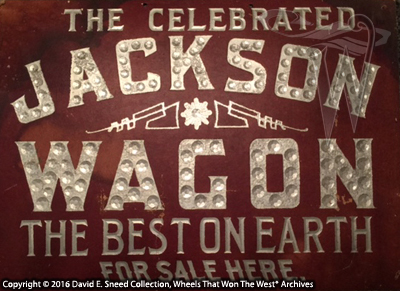
This store window sign promoting Jackson Wagons is a rare survivor.  It’s colored with reflective dots for added visibility at night.


Okay.  You back?  Pretty slim pickens, huh?  Yes, you likely ran across some literature from the late 1800’s but did any of it carry the 1870’s and earlier look of the brand?  Even rarer will be the discovery of almost any photos of this brand.  The same phenomenon exists with wagons built by Joseph Murphy, Louis Espenschied, Alexander Caldwell, Augustine Cooper, and many more  –  in fact, finding any photo showing a wagon still emblazoned with its clearly-labeled brand taken at or before the year 1880 is a tall order.

So, back to why this is important…  I think I was at the third point – How can we, as stewards of America’s western history, not know more about the vehicles that made the trek west possible?  By the same token, how can any story of the West be fully told (at least correctly) without including these amazing wheels of commerce and competition?  Fourth – How many of these legendary western wheels are still out there and, fifth, how can we recognize them without primary source documentation like these photos?

Ultimately, that’s what keeps me focused and intrigued by this subject.  It’s impossible to always know what’s around the next corner – but, when those lost gems of history do show up, it can be pretty exciting as each one provides even more understanding of not just how the west was won but who did it.  So, keep your eyes peeled and if you should happen to run across a heavily weathered, beaten down Jackson, don’t be afraid to gather it up and take it home.  No matter the condition, any of these relics confirmed to be from the 1870’s and ‘80’s are extremely rare parts from an internationally renowned past.  As the folks building wagons in Jackson, Michigan might have said, “It’s just good Common Sense!”
By the way, if you haven’t signed up to receive this weekly blog via e-mail, just type your address in the "Follow By E-mail" section above.  You'll receive a confirmation e-mail that you'll need to verify before you're officially on board.  Once that's done, you'll receive an email every time we update the blog.  Please don't hesitate to let us know if we can be of assistance.  We appreciate your continued feedback and look forward to sharing even more throughout the year. 

Have a good week!


Please Note:  As with each of our blog writings, all imagery and text is copyrighted with All Rights Reserved.  The material may not be broadcast, published, rewritten, or redistributed without prior written permission from David E. Sneed, Wheels That Won The West® Archives.